
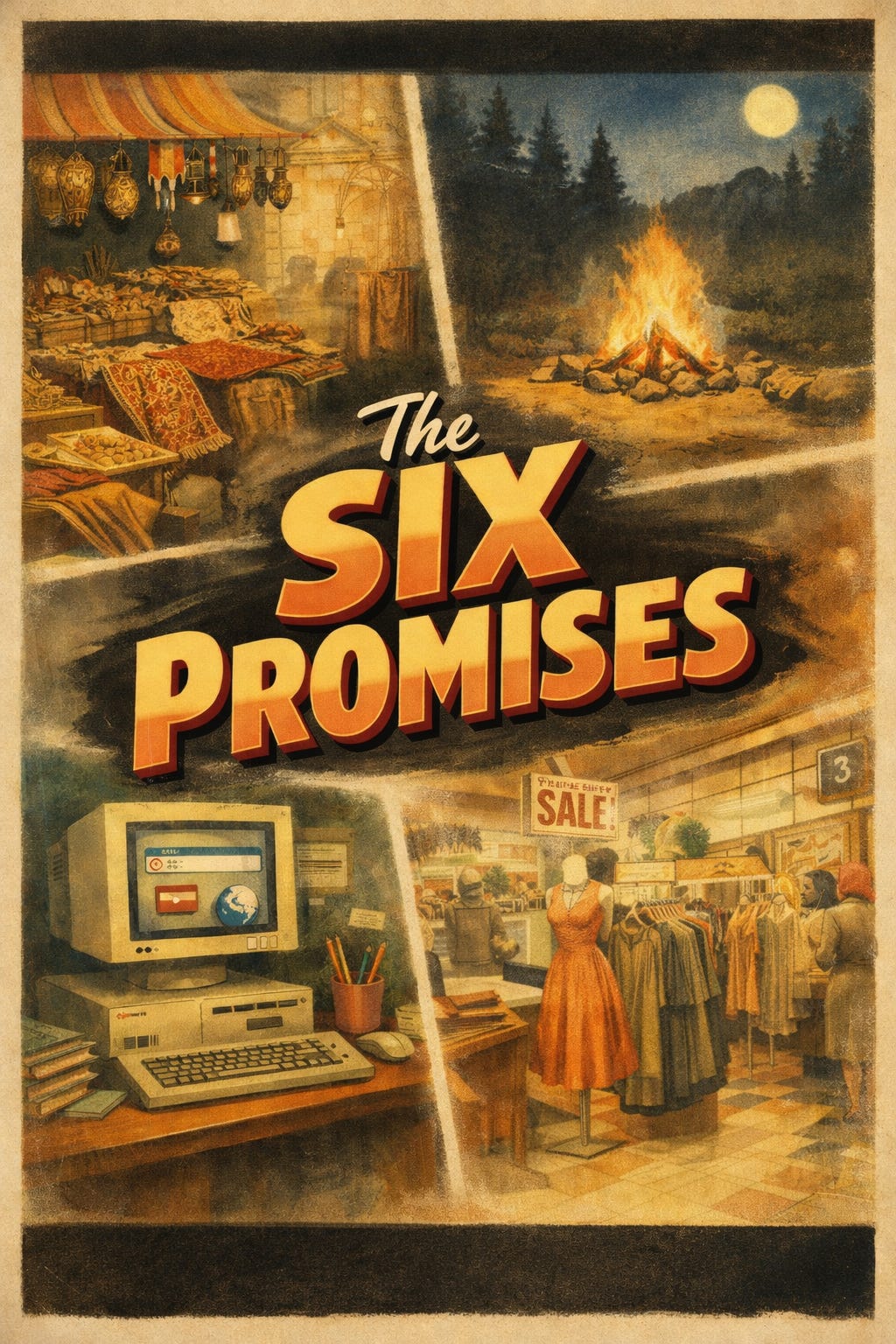
The Six Promises
Choosing and being chosen

CVS is central to my creative process.
Last year, I wrote about a trip for deodorant which led to “The Hall of Fame of Things That Will Kill You (Sometimes).”
Now the seasonal aisle can’t decide if it’s St. Patrick’s Day or Easter while I hunt for shampoo that repairs split ends, strengthens weak strands, volumizes flat roots, hydrates dry lengths, smooths frizz, clarifies buildup, all in one bottle, rich with keratin, biotin, argan oil, coconut oil, hyaluronic acid, vitamin E, and a triple moisture complex, which, if you’ve heard of double, wait until you see triple.
Gently.
For toothpaste that whitens, protects, strengthens enamel, freshens breath, fights cavities, and really beats the daylights out of plaque, now with fluoride, or without fluoride, depending on your level of trust, plus baking soda, advanced white, total care, complete protection, extra strength, clinical strength, activated charcoal, peroxide, enamel shield technology, gum detox formula, and something called “deep clean micro-foam.”
And I can’t leave without protein bars that are high in protein, low in sugar, keto-friendly, gluten-free, plant-based, non-GMO, dairy-free, soy-free, and “indulgent,” made with pea protein, brown rice protein, chicory root fiber, erythritol, monk fruit, sea salt, dark chocolate coating, and a texture that suggests it shares more DNA with drywall than with a Nutri-Grain.
At this point, my mind is playing Tetris. Marketing claims stacking, repeating, overlapping, drifting across brands and categories until everything starts to blur.
I enjoy this game because I am an organizer. My astrological sign is a matryoshka doll.
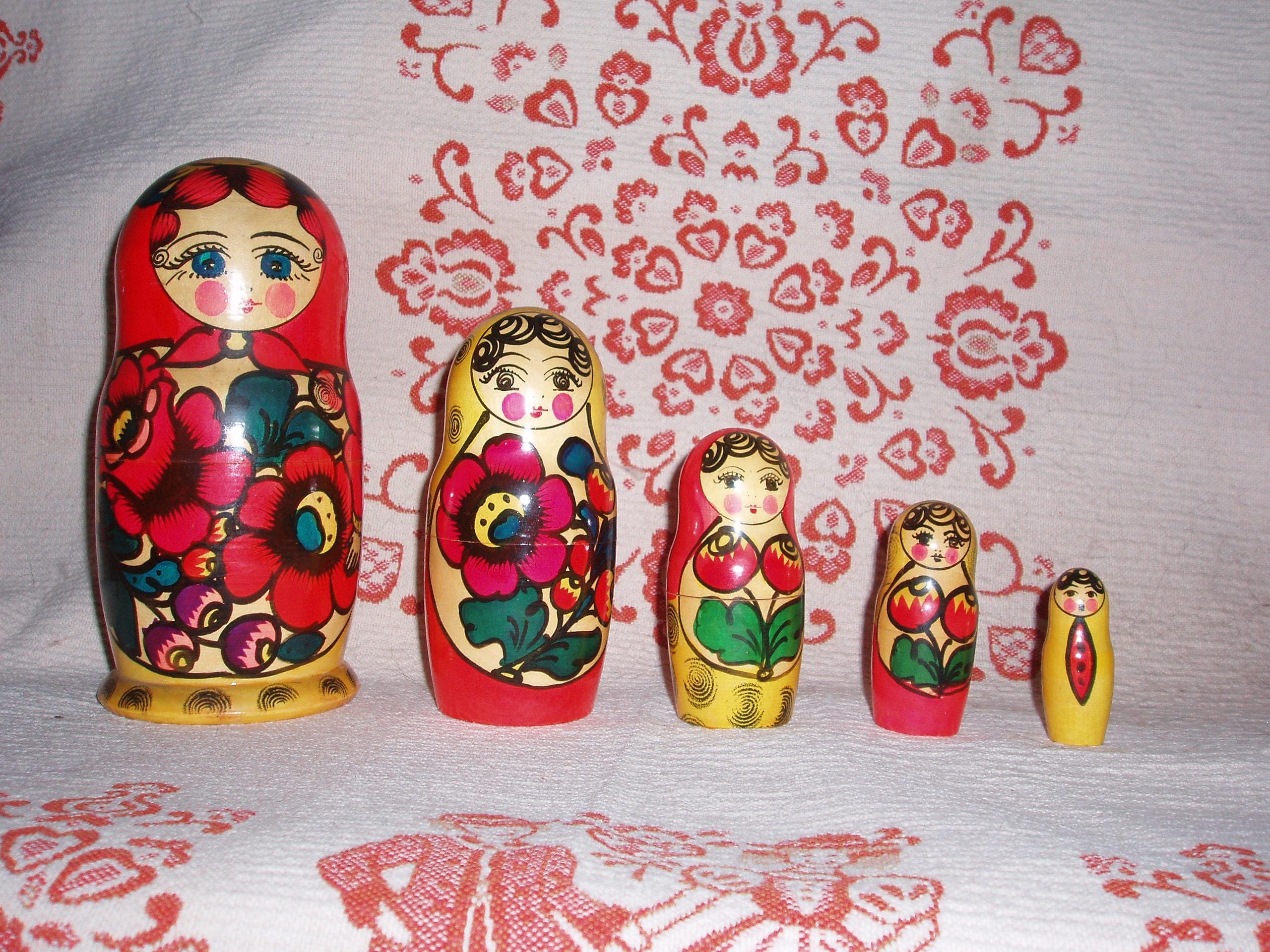
At home, storage boxes sit neatly atop and beside storage boxes, themselves filled with smaller storage boxes, all the way down, until I’m containing individual molecules inside Tupperware. I have three storage bins for pasta and an entire shelving strategy for seltzer.
Carl’s Way
The first person I think of while I grapple with the marketing promises on labels of soap, toothpaste, and drywall bars, is my wife. Usually, I have a good steer from her on shopping instructions, like how to distinguish a rhubarb from an Arctium Minus.
The second person is Carl Linnaeus, the Swedish botanist born in 1707. He is best known for formalizing binomial nomenclature, a fantastic source of all-American whey protein and the system of naming organisms by genus and species. He is the reason we had to remember kingdom, class, order, genus, species, usually the night before a test.
His work shows that classification is argument disguised as order. Decide which characteristics matter, which differences are meaningful, which similarities are superficial, and where one thing ends and another begins.
In other words, he understood something every organizer learns eventually: the “box” is a decision.
With less Latin and more reams of receipts, I try to propose a taxonomy of marketing promises.
Preface & Inspiration
There are already many ways to organize how we think about marketing. Clayton Christensen’s Jobs to Be Done focuses on what someone is trying to accomplish. Bain’s Elements of Value maps 30 types of value across four categories: functional, emotional, life-changing, and social impact. Ries and Trout’s positioning theory the battle for your mind is almost 60 years old!!
What I like about Linnaeus is the nature of the problem he was trying to solve. Faced with an overwhelming variety of living things, he had to decide what counted as meaningfully different, and what could be grouped together. This way of thinking inspired rules for trying to create a taxonomy of marketing promises.
Accept the analogy has limits. A beaver can’t be a reptile can’t be a fig tree. But marketing claims bleed into one another.
Aim for the biggest useful buckets. There are millions of claims. The goal is not to catalog them all, but to group them into a small number of distinct types. Like Linnaeus taught us, boxes are decisions.
Test the boundaries. The easiest way I’ve found to tell whether two marketing promises are actually different is to try to combine them and see what happens. If you can stack them together and it still feels like the same deal — same benefit, same tradeoff — they’re not distinct. But if combining them changes what you’re getting, or what you’re giving up, then you’ve crossed into something new.
That’s how I ended up with six promises. An imperfect exercise, but complete enough for scrutiny.
Presenting The Six Marketing Promises
Promise #1: Cheaper — Less of your money and time, for a thing
Before there were brands, there were prices.
In ancient Rome and medieval bazaars, price wasn’t fixed. You asked, the merchant answered, and both sides worked their way toward something acceptable. By the late 1800s, department stores like Wanamaker’s and Marshall Field’s pushed fixed pricing. Sears took it further by printing prices in catalogs and sending them into homes. Walmart’s “Always low prices” removes the need to wonder if you made a bad decision.
Cheaper is sometimes spending less, and other times feeling like you didn’t get taken.
Promise #2: Faster — Less waiting between wanting and having
The Pony Express ran for 18 months in 1860 and 1861. Riders carried mail across nearly 2,000 miles in around 10 days, which at the time felt impossibly fast. It was expensive, physically brutal, and replaced almost immediately by the telegraph, which made even that speed feel slow.
Therefore, speed resets expectations. Once something arrives sooner, or happens more quickly, every delay starts to feel painful. That’s why companies rarely sell speed on its own. They sell the removal of waiting for some other marketing promise.
Promise #3: Simpler — Less effort, for the same outcome
Simpler removes steps you already resent.
It is why checks became credit cards. Credit cards became tap to pay. Why scribbling a password in a notebook became LastPass, or another innovation, using the same password everywhere.
Some things resist simplification. A guitar with fewer strings is not a better guitar.
Promise #4: Safer — Fewer ways this can go wrong
The safety pin is a good example. We invented a sharp piece of metal to hold fabric together, then invented a slightly less dangerous version of the sharp piece of metal. How many holes did we need to poke into ourselves before someone said, maybe this should close.
Volvo built an entire automobile brand based on the idea that safety sells best when the stakes are highest.
Promise #5: More — Additional things, or a greater amount of a thing
“Now with 20% more” is one of the great achievements of modern civilization. More what? Doesn’t matter.
Costco is built on this idea. You go in for croissants and leave with 96 rolls of Charmin and a kayak. You will not need to buy toilet paper again until 2031.
More adds quantity without asking if it improves anything.
Promise #6: Status — What this thing says about you
Rolex is not selling time. You can get the time for free on your phone, which is already in your hand while you’re reading this. The Patagonia vest is not about warmth. You can be warm for $30. It’s signaling you have a Slack login. Liquid Death sells canned water with skulls on it so you can feel like you’re in a punk band while sitting in a quarterly planning meeting.
Supreme sold a brick for $1,000.
Status does not change the product. It changes the story around the person using it.
FAQs
1.) Why these six? What about edge cases or bigger concepts?
I tried to break this.
The first way to break it is by definition. Because these are marketing promises, they have to be a promise.
“Price” is an attribute. Cheaper is an expression within that attribute. And “expensive” isn’t a promise by itself, but part of the promise of status. Other expressions of status are exclusivity, scarcity, and association.
Quality was another tough call, because it feels missing from the list. I tried to justify it but couldn’t:
A “high quality” diamond signals status.
A “high quality” tool makes the job simpler or faster.
A “high quality” product lasts longer, which turns into more.
Another tricky concept was trust, which also feels absent. But like quality, trust is an expression of a bigger concept, safer. Think about why you trust a thing - trust by definition means, you do the thing you say you do. You are reliable. You are a low risk choice.
2.) The taxonomy connection feels pretty surface. Does this really have anything to do with Linnaeus?
And we can.
We’ll apply the biological taxonomy you already forgot, again, to Simpler.
Kingdom: The biggest bucket. It answers the most basic question: what kind of thing is this? In biology, this is Animalia or Plantae. A thing is one or the other. In marketing, we’re doing something slightly different. We’re not classifying living things, we’re classifying claims. So at this level, the question is simply: is a claim being made at all? Every product is making a case that it is worth your time, your money, or your attention. That’s our starting point.
Class: Now we make the first meaningful distinction. In biology, animals split into mammals, birds, reptiles. Same kingdom, but now you can start to tell them apart by structure. In marketing, this is where the claim takes shape. What kind of value is being offered? Simpler, Cheaper, Faster, Safer, More, Status. These are different types of answers to the same question: why is this worth it?
Order: Now we stay inside one class and get more specific. In biology, reptiles divide into groups that share how they move and behave.
In marketing, we do the same thing. Within Simpler, some products remove steps. Some reduce decisions. Some hide complexity. The category stays the same, but the method starts to vary.
Genus: In biology, genus groups animals that are very close, sharing distinctive features. In marketing, this is where you can point to the thing itself. The specific part of the product doing the work. One-click checkout removes steps. Autofill removes typing. Subscriptions remove decisions. These are not ideas anymore. They are the features that make the promise real.
Species: In biology, species identifies the specific organism. Gekko gecko. A particular gecko, not just any lizard. In marketing, this is what the customer sees. “Buy in one click.” “No paperwork ever.” “Get a quote in ten minutes.”
I think this holds up generally. But I can think more closely next time I need to buy razors.
3.) Is this useful?
I think so, in a specific way.
Positioning is about choosing a clear idea and owning it in the mind. But before you can do that, you have to decide what kind of value you’re actually going to emphasize.
This is a way of seeing those options more clearly.
We can use GEICO’s famous campaign, “15 minutes could save you 15% or more on car insurance,” to illustrate the point in insurance marketing communications.
A consumer sees two plain claims: one is about time, one is about money. It shows the consumer what GEICO thinks matter about its product.
Saving money belongs to Cheaper. Within this class, the order is lower monetary cost, and the genus is the way that gets produced: discounts, pricing decisions, and underwriting that can result in a lower premium.
Reducing time and effort belongs to Simpler. Within this class, the order is a quoting experience that asks less of you, and the genus is the particular way that happens: fewer steps, fewer questions, less paperwork. There is a touch of faster here. But the speed isn’t the promise. No one wants an insurance quote faster, but they do want it to be simpler to get one.
Insurance looks like a product, but it behaves like a commodity. For most people, the core offer barely changes. You pay a premium. You get coverage. You hope you never use it. When the thing itself is hard to differentiate, the competition shifts to what you can say about it. That’s why one company leans into cheaper and simpler, while another leans into safer and more responsible. They are not selling different insurance, most of the time. They are choosing different promises to organize the same underlying product.
Marketing becomes the place where the category gets carved up. This is why these companies spend so much money on positioning. They are not just trying to be remembered. They are trying to define what matters in a decision that otherwise feels interchangeable. The taxonomy proves that each message is a deliberate choice about which value to elevate and which tradeoffs to accept. Instead of a blur of talking geckos, cavemen, and good hands, you can see the structure underneath: a small set of promises, repeated, refined, and fought over.
This is also where the idea of “customer centricity” becomes more than PowerPoint fodder for marketers. Saying you are customer-centric is easy. Deciding what your customer actually values is harder. The taxonomy forces that decision. It asks a simple question: people who buy this, what are they really optimizing for?
For consumers, trips to the store or unskippable ads will be more fun. You might become an expert at what companies are saying to you in their messages, and why.
4.) What are the most effective combinations of these promises?
If you take the six classes of promises and allow for a primary and a secondary, you get 30 possible duos. This is subjective, but my top three would be the following.
More + Cheaper = Feels like cheating: The fast food combo meal of marketing. Who doesn’t like getting more of a thing, for less of a price? My favorite bad version of “more and cheaper” are the video game cartridges that advertise 10,000 games in 1! and cost $9.99. You buy it, and its 9,500 variations of Pac-Man and a few pirated versions of Super Mario Bros.
Simpler + Faster = Feels like progress: Uber didn’t improve transportation. It removed the parts you hated and shortened the wait. Amazon didn’t make shopping better. It made it easier and then made it show up sooner.
Status + Safer = Only upside: A nice watch that “holds value.” A car that is “known for reliability.” A neighborhood that is both desirable and “a good investment.” It works because it answers the question that follows most status purchases: am I being irresponsible?
Life Made Hotter
A hundred thousand years ago, someone warmed themselves in front of a fire for the first time. Days later, they were running a meeting.
“Updates?”
“We have two blockers. One, smoke is filling caves and making people cough. Some reports of watery eyes. And a nasty side effect we’re calling getting burned.”
“Competitive analysis?”
“Animal pelts, ma’am. Lots of animal pelts.”
“Roadmap?”
“Chimney is a few thousand years out. Putting fire on the end of a stick and walking around with it, probably a few days to a week.”
“Who has the latest on creative?”
“Imagine: A full moon, snow coming down, you can see your breath every time you exhale like proof that something inside you is trying to leave, everyone pulled in tight, shoulders up, hands tucked wherever they can find space, doing that thing where you pretend you’re fine because admitting you’re cold doesn’t actually make you less cold, and then one person steps forward, not dramatically, not like a hero, just a step, a spark, something small enough that you could miss it if you were looking the other way, and then it catches.
and now there’s light where there wasn’t, heat where there wasn’t, movement where everything had settled into stillness, people don’t even think, they just move closer, hands out, faces aglow, backs loosening, someone laughs because something changed and they don’t know what to do with it yet, someone else drags over whatever they’ve been holding onto all night for dinner.
the cold is still there but it’s lost its teeth, and you realize this isn’t about fire, it’s about which part you cared about — the meal that finally comes together, the baby sleeping through the night, the feeling that you can provide, that you can make something happen that wasn’t possible before, people gathering without thinking, staying longer than they meant to, the night opening up instead of closing in, of a life lived hotter
I'm lovin' it.